

SMARTInsideTM
Your personal development coach
Change or Replace a Habit
A habit is a behavior that occurs automatically in specific situations. It is very difficult to eliminate, change, or replace habits because they are encoded as closed-loop neuron patterns in your brain: once the habit pattern launches, it is hard to stop.
The habit cycle goes like this: Something happens in or around you (the signal) that triggers a behavior (the automatic response). This action satisfies some craving – at least in the moment.
For example, you say you want to go to the gym after work. Usually, after getting home, the first thing you do is change your clothes. Right after changing your clothes (the signal) you pour your favorite beverage and sit on your couch for a rest (the automatic response). The urge to do this is strong, and the anticipation of a time to relax and enjoy something that tastes good (the reward) takes over. You put off the gym until tomorrow.
Here are the STEPS for doing this:
To change or adopt a habit, you have to break old behavior cycles or insert something new in your already busy life. Possibly the most important factor will be your persistence.
Habit change is often difficult. Discipline and persistence are critical, not only to plan a successful process, but to implement it. Create or Change a Habit (in Tools). This step-by-step guide wil help you be more successful in this most important of self-evolution activities.
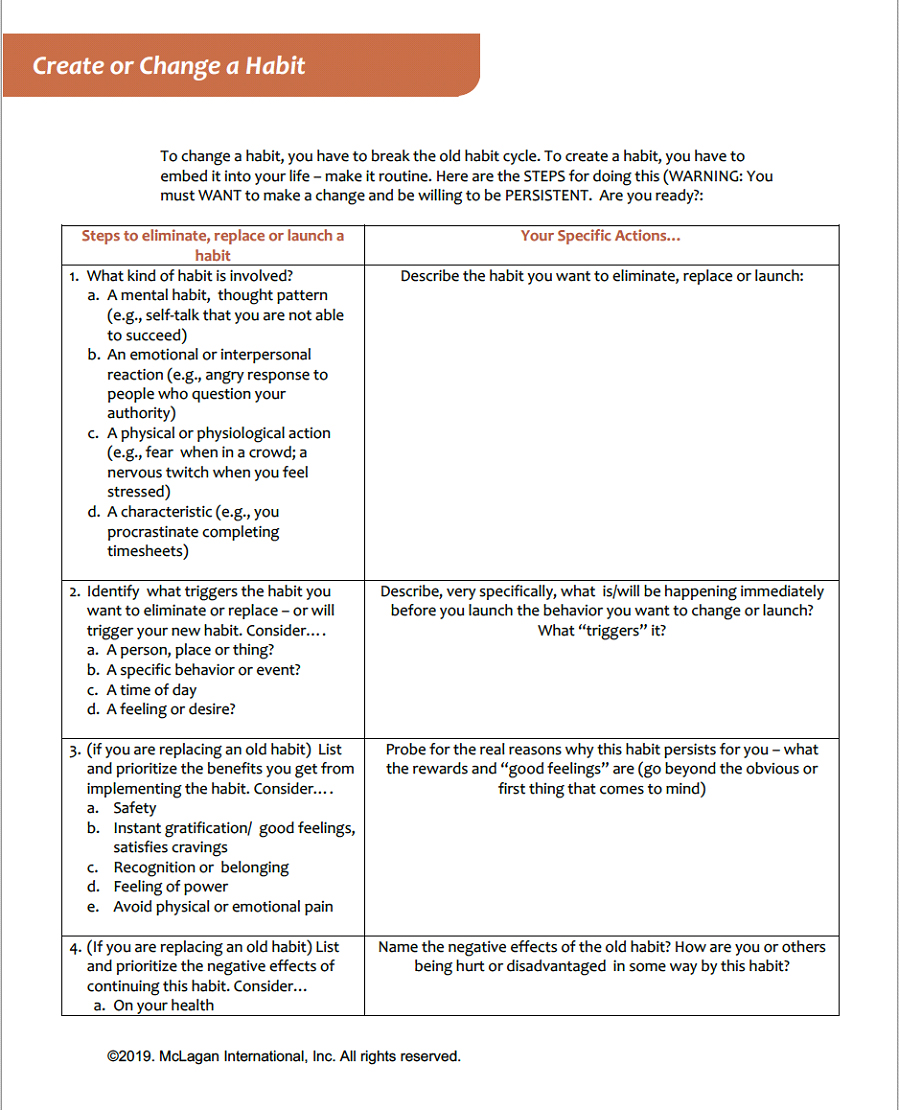
Identify the habit type:
Describe the habit you want to eliminate or replace
Identify the triggers. What is happening right before you launch your habit or plan to launch your habit?
Describe, very specifically, what is happening immediately before you launch the behavior you want to change. What “triggers” it?
Use Create or Change a Habit (in Tools) as a place to organize your thoughts.
Consider…
Probe for the real reasons why this habit persists for you – what the rewards are (go beyond the obvious or first thing that comes to mind)
Use Create or Change a Habit (in Tools) as a place to organize your thoughts.
Consider the negative effects on such areas as…
Name the negative effects of the old habit. How are you or others being hurt or disadvantaged in some way by this habit?
Use Create or Change a Habit (in Tools) as a place to organize your thoughts.
What is…
Describe the new behavior you want to put in place whenever the trigger(s) in #2 occurs?
Use Create or Change a Habit (in Tools) as a place to organize your thoughts
Write your intentions in this format:
Adjust your change management timeframe to match the difficulty of your habit change process.
Use Create or Change a Habit (in Tools) as a place to organize your thoughts
Be patient and diligent. Keep score and build your willpower step by step.