
Your personal development coach

Have a Helping Mindset

The attitude and intentions you bring when you help others play a big part in both of your success. If you feel obligated and not committed to the other’s personal development and growth, it will be obvious. It will be an obstacle to both your relationship and its impact. If you truly want to be a catalyst for another’s growth and vitality, it will be obvious and there will be a good probability that the relationship will succeed.

Remember, it’s all about the other person, not you.

  • Be aware of and respond to what the learner needs. It is NOT your agenda.
  • Commit to helping the person become more adept in an area important to him or her as well as to become a SMARTer learner. You are there to support the process, not to do or control the learning.
  • Create a climate where it is okay for the person to be a novice, try things, make mistakes and learn from them.

Let the SMART Learning 4.0 Framework be your guide. It is a comprehensive and flexible learning framework to guide learning and development – one of the most important life processes we possess.

  • Review the section in this App called About Learning 4.0. Be aware of what is now relevant to the learner in these areas:
    • Contexts. Learning happens in 3 contexts (alone, with others, and when helping others – some formal, some informal)
    • Paths. Learning may focus on past experiences, what’s happening now, and what the person wants to happen in the future
    • Qualities. Advanced, 21st Century learners have high doses of special qualities – like imagination, ability to co-evolve with technology, and more
    • Practices. There are 7 important learning practice areas, each requiring a variety of tactics. These are also stages in the learning process.

Show him/her the Learning 4.0 Framework – describe what it means to be a SMART learner.
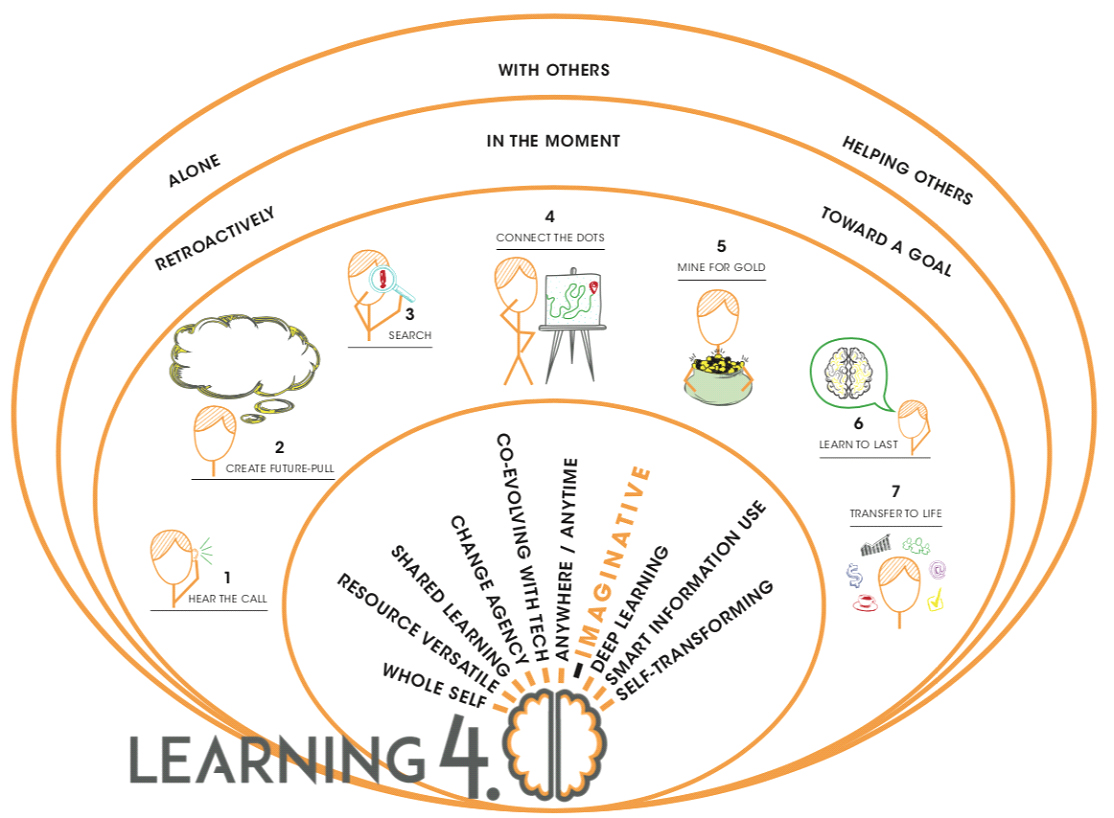
Notice what learning stage the person is in related to any specific learning goal. Which of the 7 Practices of Learning 4.0 are most relevant at this moment:

  • Hear the Call: is the person fully aware of what is driving the need to learn, develop, change?
  • Create Future Pull: does the person have a motivating, multi-sensory awareness of what s/he wants to create in life and work?
  • Search: Is the person aware of the variety of resources and experiences to use as s/he learns?
  • Connect the Dots: is the person at a stage where s/he can create plan and timeline for any capability that will take time and persistence to develop?
  • Mine for Gold: is the person able to use advanced techniques for processing information and experiences: concentrating, doing deeper learning, dealing with information distortion and bias, efficiently learning from a variety of resources?
  • Learn to Last: can the person benefit from better techniques for remembering, for skill development, to recognized and update attitudes and beliefs, to be a more creative learner?
  • Transfer to Life: is it time to bring new knowledge, skills, and attitudes into daily life and work? Encourage the use of the Tips and Tools in this App