
Your personal development coach

Remember What You Are Learning

It’s not enough to concentrate), use great techniques for learning from any resource, or even to mine for deeper gold. (There are tips in this App for all of these.) It’s important, in addition, to take special steps to make this information your own to use now and in the future. This tip will help you better store and be able to retrieve information you want to remember.

Create a memorable sentence describing something you can visualize: the first letters of each word link with what you want to remember

  • E.g,, the four learning outcomes are Remembering, Skills, Attitude updates, and Creative Ideas. A memory trigger sentence could be “Robots Save All Competencies”

Create a memorable graphic mental image that connects the items you want to remember.

  • E.g., Here’s an image to help you remember the 7 SMART Learning 4.0 Practices. Imagine…
    • You are hearing calls to learn from all directions.
    • You have an imagination thought bubble over your head (for Future Pull)…
    • And are searching (Search) far and wide for ..
    • Dots to connect (Connect the Dots)
    • You are wearing a gold miner’s helmet (Mine for Gold)..
    • And holding a blue ribbon that says. “I Learn to Last.”
    • Someone important to you is thanking you for helping make changes (Transfer to Life)

Use an anchor list – a list of memorable items that you frequently use to anchor what you want to remember. Then for each item on your list, make a memorable association with the anchor image (e.g., you want to remember to talk to Sam about your SMART Inside progress.. Using the list below, you imagine Sam eating a gigantic SMART bun)

  • Sample, reusable anchor list:
    • One is a bun
    • Two is a shoe
    • Three is a tree
    • Four is a door
    • Five is a hive
    • Six is sticks
    • Seven is heaven
    • Eight is a gate
    • Nine is a vine
    • Ten is a hen.

This anchor list is great for remembering what to pick up at the store or in the store room!

Draw or diagram a tree showing the ideas and steps you want to remember – show how each idea, fact, step, etc. connects to or supports the others.
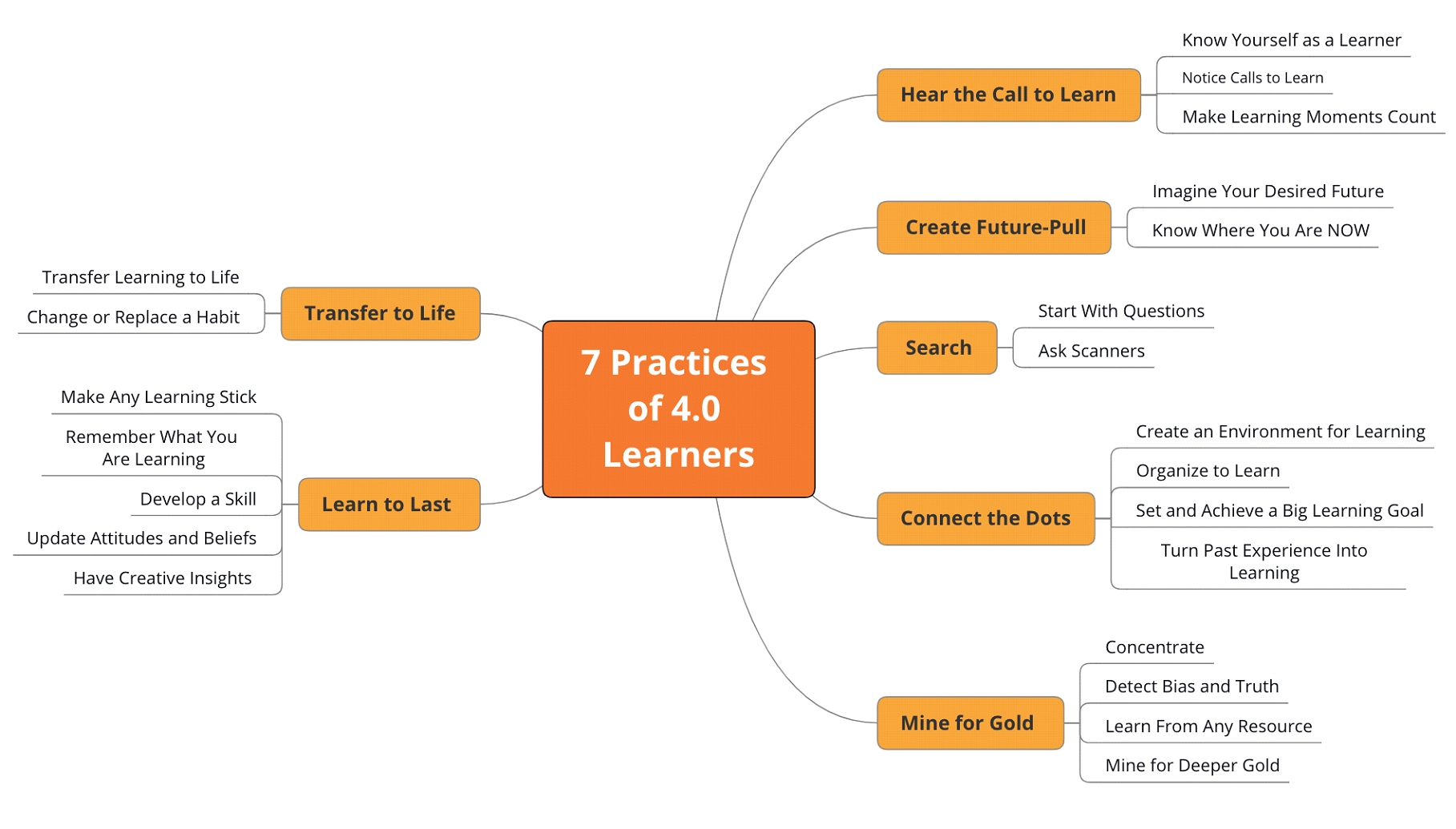
  • Think of big ideas as the main limbs of a tree, supporting information as smaller branches. Twigs and even leaves can be for the supporting points on the branches. Here is an idea diagram of the 7 SMART Learning 4.0 Practices.
  • Make diagrams that show relationships and connections –that show how some information supports or is part of other information. This will help your brain know how you want to store information.
  • You are more likely to remember details because they are connected to bigger ideas.

Move around while you do some of your learning

  • Many memories are connected to places and triggered when you return to those places – so move around while you learn (“I learned xxx while I was walking in the city gardens”)
  • Moving helps keep oxygen flowing – helps you keep attentive and it may help generate proteins that increase the firing power of your neurons – helping them change to encode new information.

Compare what you are learning to something very different – then look for similarities as well as differences

  • Look around you and pick anything you see. Tell yourself how it is similar to, or different than, what you are learning
    • E.g., How is this new delegation method I’m learning like/not like an airplane? (Similar: I have to take a bigger view while being disconnected; Different: It is mechanical, delegation is a human process)
  • Comparing different objects or ideas in this way stimulates creative thought and creates more retention-friendly connections. You will discover more about what you are learning while also improving your concentration (you must concentrate to create the analogy.)

In reality or in your imagination, teach someone the main and important points and insights you are learning

  • Structuring your own thoughts this way helps you organize your memories and strengthen the neural paths you will use when you try to recall your learning in the future.
  • You may also discover that you missed the “Mine for Gold” step – didn’t really bring the information into your brain for longer term processing, didn’t go for deeper understanding. Or maybe you let your biases distort or avoid important learning. Go back and Mine for the Gold!

Test yourself on what you know BEFORE you learn.

  • This helps focus your attention, sets the stage for questions and discovery that will help you concentrate
  • This helps you begin to make connections between new information and what you already know – setting the stage for both long-term memory storage and later retrieval because you are connecting with what you already know.

Test yourself (recall) while you are learning…

  • Learning experts have long known that a few minutes of recalling and thinking about what you want to remember are as valuable as hours of reading, listening, taking a class – anything where you are taking information in. Without taking some consolidation time, you will forget 80% of what you thought you learned.
  • Re-reading or listening to that tape again doesn’t really count.
  • Step out of your learning to recall ideas and to think about how you will use the ideas in your work and life. Imagine your neurons using this recall time to turn temporary memories into longer term and reliable memories. Know that you are strengthening your memory retrieval pathways, even if you forget and have to look up information you forgot or missed.
  • As a memory insurance policy, map, diagram, or draw what you have learned. Again, this mirrors the connections you want to be creating in your brain.

Recall important information you want to remember -- today, tomorrow, next week….

  • If there is a lot to remember, schedule short ”total recall” sessions to answer the question, “What do I remember?” Set a smartphone or calendar reminder alert at 1 day, 3 day, one week, one month out. See these as pit stops to keep your memory machine tuned up for high performance.
  • Note that this is a technique that successful language training methods use.